
Employee listening for municipal government
Hear one workforce across many essential services
Municipalities bring together distinct departments, occupations, locations and working conditions under one public mission. TalentMap helps leaders understand the shared story, see real differences and turn feedback into priorities people can act on.

Municipalities that work with TalentMap




A workforce that cannot be understood with one headline score
A municipality may include office teams, public works, recreation, transit, emergency services and other specialized groups. Leaders need an organization-wide view without losing the realities of different departments, and employees need confidence that their feedback will be handled responsibly.
Workforce and stakeholders
Who is involved, and who needs to trust the process
Municipal listening has to be credible to unionized and non-union staff, department heads, the senior leadership team and council, and defensible when a result becomes a public question. The design starts from that mix.
Frontline and field crews
Public works, transit, parks, water, waste and emergency services, often unionized, working shifts and outdoors, and rarely at a desk when a survey opens. The participation plan matters as much as the questions.
Office, professional and program staff
Planning, finance, permits, recreation, libraries, social services and administration, spread across facilities and covered by different collective agreements, each with its own view of the organization.
Leadership, council and the public
The CAO and senior leadership team, department heads, HR, union leadership and elected council. Results may be requested by the public, so each audience needs a view it can stand behind.
Independently governed police services and public library boards are covered under Broader Public Sector; municipally operated departments and services remain here.
What municipal leaders need
Built for the way municipalities work

Relevant comparisons
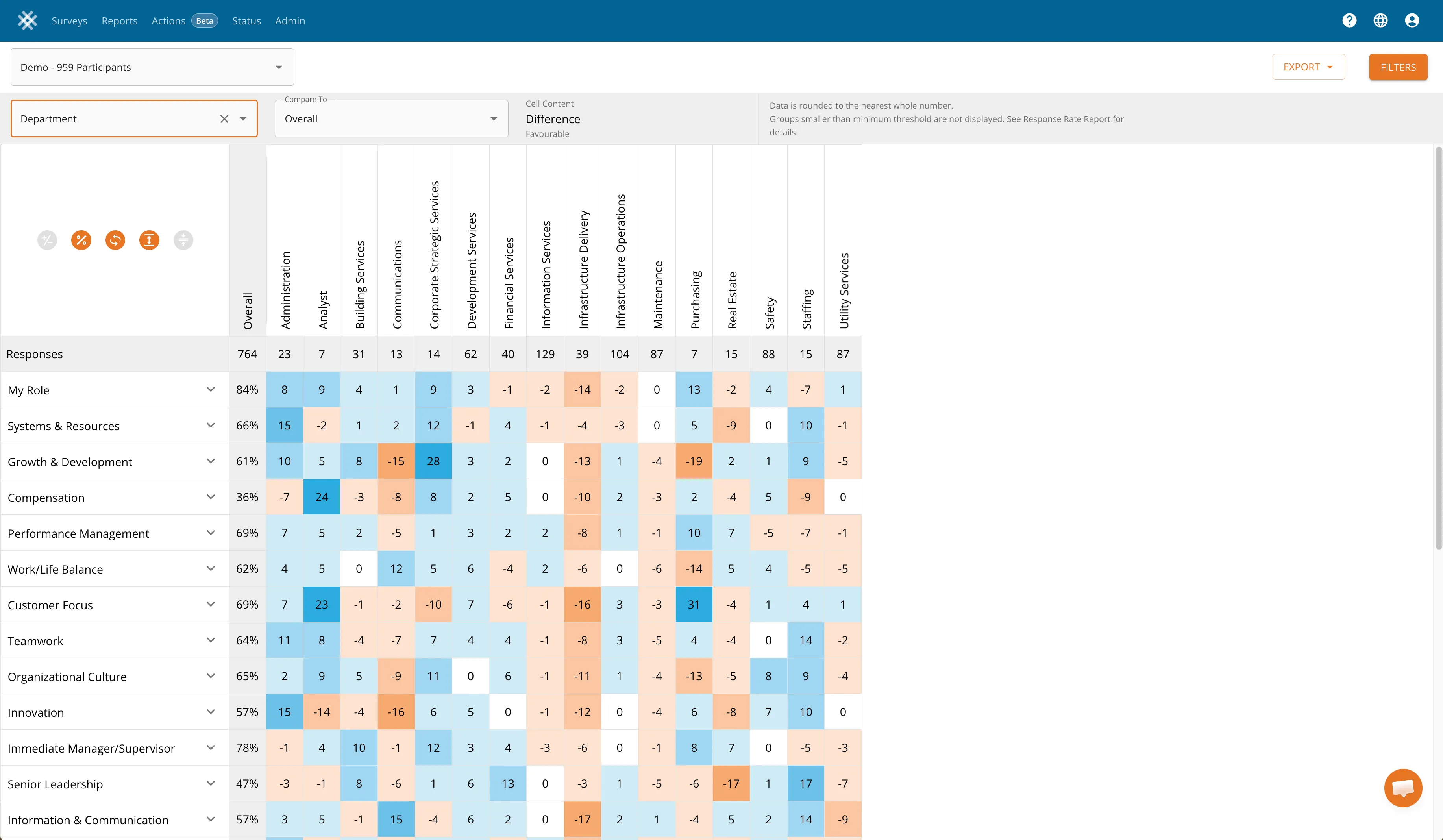
Interpret results with benchmarks and context that reflect municipal and public-sector work, rather than relying only on broad global norms.

Clear executive and council communication
Prepare a concise organizational story for senior leadership and governance discussions while keeping the underlying analysis available to HR.

Confidentiality-aware reporting
Use appropriate access and reporting controls across large departments and small teams.

Practical manager follow-through
Help department leaders understand their results, hold credible conversations and choose actions they can influence.

A sustainable listening cycle
Build a process that can continue through annual surveys, focused pulses and changing workforce priorities.

People who know the sector
Work with consultants who have run listening programs in municipalities and can read the results in that context.
Trust and confidentiality
Make it safe to respond and responsible to report
Municipal employees know results can end up in a council report or a media request. Explain plainly what is collected, who can see results, how small departments and crews are protected, and how the organization will communicate back.
Common listening priorities
The questions municipalities ask most

Recruitment and retention
Leadership confidence

Communication and change

Employee wellbeing

Inclusion and respect

Collaboration across departments
Service culture

Learning and career development
How TalentMap supports the process
Six steps from priorities to progress
01
Fit the survey to municipal priorities and decisions.
02
Prepare communications and participation plans for a varied workforce.
03
Deploy the survey and monitor response.
04
Interpret results with relevant context and benchmarks.
05
Prepare leaders and managers for focused action.
06
Continue the cycle and review progress.
Common questions from municipalities
Can different departments receive their own results?
Yes. Department and division leaders can see their own results within confidentiality thresholds, alongside the organization-wide view.
How is confidentiality protected for small teams?
Engagement survey results are reported in aggregate. Groups with fewer than five respondents are not reported on their own, so no individual can be identified.
Can deskless employees participate?
Yes. Surveys can run with an access code instead of a work email, and we plan participation for crews and shift workers as part of survey setup.
Can we compare results with other municipalities?
Where a relevant municipal or public-sector benchmark is available, yes. We are clear about what each comparison contains.
What support is available after results are delivered?
Interpretation, council and executive presentations, manager preparation and action-planning support, depending on the services you choose.
Keep exploring

All industries
See how listening changes across the sectors TalentMap serves.
Explore industries

Insights
Research, articles and practical guides on employee listening and action planning.
Explore insights
References
Looking for an example from your sector? Contact us to ask about relevant references.
Ask about references
Build a municipal listening program leaders can use
Tell us about your workforce, priorities and current approach. We will show you how TalentMap can support a credible path from feedback to action.